"hard times ain't gonna rule my mind no more."
some thoughts on writing about poverty & the ethics of hopeful narratives
P and I spent last week driving through Virginia. We were visiting family and friends, and also taking time to write and (for P) research the region. The short essay below reflects on some of the difficult feelings I had driving through the especially poor, rural areas of the state. Poor, rural areas always get me emotional because they remind me of my childhood. I write about making sense of these spaces, as a writer, through the tricky mix of feelings and political awareness. I’m keeping it below the paywall because it feels a bit vulnerable. Consider upgrading to paid (only $33) for access to these more personal essays as well as a bunch of goodies in the weekly Friday note. <3
We’re driving through Appalachia in a summer of genocide and ICE raids and new bombs and I am trying not to feel the way I am feeling about the paraplegic man who is waving at us, emphatically, from his wheelchair in the front lawn of a church. The sign behind him reads: “Exposure to the Son Prevents Burns” -- the car dash says it’s 99°outside. The way I am feeling about this man in the wheelchair that I do not want to be feeling is the way a writer feels when they see something and think, This is a story. I see this man and I think of metaphors, I think of the juxtaposition of the church sign next to ecocide. I think of the juxtaposition of his disabled body next to an image of my own father, also a poor white man in a wheelchair whose mom made him—only after his brain injury— trust in god because there was nothing else to offer. I am thinking of these men as symbols of rural poverty, I am thinking of how inclined I am to want to soften towards the toothless, long-haired kind of men who (like my father) might be found at a racetrack or a shitty country bar. I am thinking about how some of my peers would see these men—before their wheelchairs— as enemies, as Trumpers, as the problem of violent or toxic or stupid masculinity. It is not that the feminist critique of masculinity is wrong, but so often it is incomplete.
So anyway, I feel guilty for thinking about this man as a symbol more than an individual. For considering the concept of his archetype — the white rural man who statistically has been violent to his wife or his kids or a constructed enemy in a war, who maybe voted for Trump (although it’s just as likely he didn’t vote at all), who is probably a fan of guns — alongside his immobility. These monsters we imagine, with no legs to stand on. These monsters who are both upholders and victims of the structures we’ve yet to topple. I want to humanize these kinds of men, and I also want to use them for art, and I also want to stop them. I am thinking of all of this as we drive by, as he waves, as Gillian Welch sings on our car stereo, “hard times/ ain’t gonna rule my mind no more.”
“Hard Times” begins with the story of a plow man who “loved his mule and that mule loved him.” The worker, Welch describes in the lyrics, is exceedingly optimistic; “we’re gonna make it yet to the end of the road,” he tells his sweet animal friend. They won’t let hard times get them down. This finding joy—or at least rejecting constant despair— amidst impossible conditions is why it’s hard for me not to see poetry in poverty. If a rich person wrote what I just wrote, my blood would boil. Once I listened to a wealthy white 20-year-old at an Ivy League university talk about the beauty of the dilapidated buildings in Detroit. I hated her! I make an exception for myself because I grew up poor—and have had times in my adult life below the poverty line, too—but I know I might be just as enraging. Still, I can’t help but cling to these reminders of joy in the most destitute places: the smile on this waving man’s face; the videos of children in Palestine playing with abandon; my own memories of the ridiculous fun I had in childhood, even the years mom was most broke.
Before we were in the Blue Ridge, we were on the Chesapeake Bay. We saw poor folks there, too, more Black folks than white, but not the kind the TV shows. We weren’t in Detroit, we were on the water, and the working people were crabbers and sailors, and they were Black. We talked to one older man, who told us about his old boat, Glory Ann. He was wearing camo and work boots. He’d been working his whole life. He sounded peaceful, but also tired.
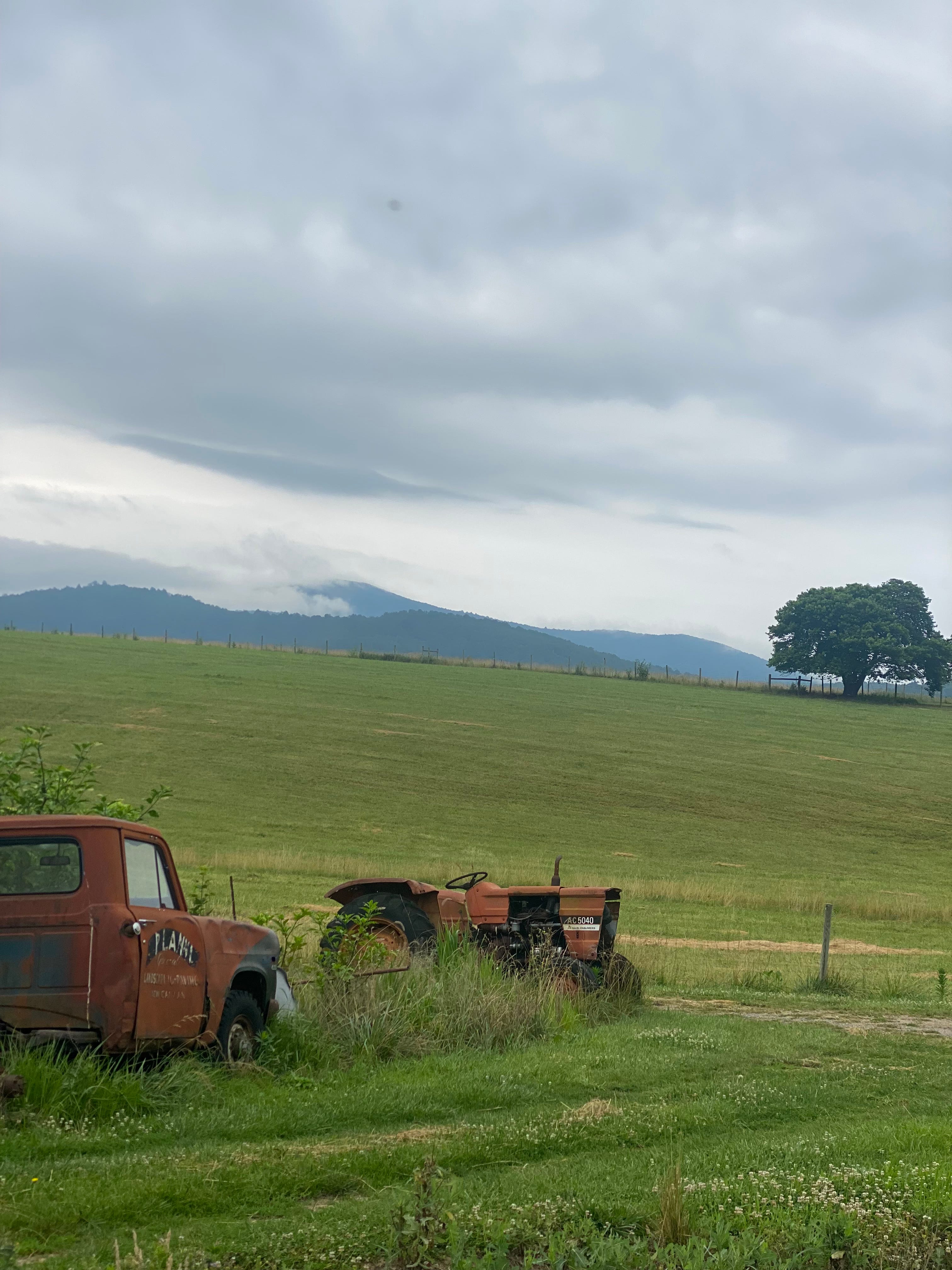
I’ve never been able to look at a rusty old pickup truck by a broken down shed without the press of my heart against my sternum. I don’t know how to hear an old man talk about his crabbing boat with such warmth and not feel like there is some indispensable meaning-making in all this hard work. How do we write about poverty, trauma, and horror without looking for hope in it? Is it better to look at the world like a poem, or to admit it’s uglier than the flowery language with which we tell about it? I don’t know the answer, but I know I wanted to tell you about these men and these trucks and boats, and how it felt to consider them in this moment of collapse. How they felt beautiful and devastating; how so much of being alive right now feels beautiful and devastating.
At the end of “Hard Times,” the man stops plowing. His mule has died, and he doesn’t sing anymore either. But Welch implores us to remind him: “Hard times ain’t gonna rule my mind no more.” My voice always shakes when I sing along to the last chorus.
I’m glad for the reminder too.


This writing is beautiful and devastating, like seeing Gillian Welch and Dave Rawlings live, which I did a few months ago. It was transcendent.
I remember talking with a guy I graduated from college with one night, how he wanted to work construction, he felt like it was honest, and he would just be so tired that he wouldn’t care about anything. I was so annoyed by him-I told him he didn’t have to worry about anything for real because he had money. That fetishization of physical labor by the affluent is infuriating.
Where were you on the Bay?
Reading this makes me think about the music of SG Goodman. I think you’d dig her stuff