a staccato pattern of living.
a note on snow, chemo, & nick cave | + lists, links, & recs <3
Dear ones,
Before I get into the note I felt compelled to write to you this week, I want to share something I heard Nick Cave say in his interview on the On Being podcast. Cave is a beloved musician who has been creating dark, moody post-punk records since the late 70s. I was introduced to him in high school, on a mixtape, through the song “Into My Arms”; I was transfixed with his impossibly low voice, and how the simple but profound lyrics coalesced into what I’d consider to be one of the greatest love songs of all time. Cave is known for making unusual and superb art and for being weird— he was doing ‘lifestyle-Goth’ before that was really a thing. But what he’s also known for now is grief: he lost two sons, one who was 15, the other 31. During his interview on the spiritual, NPR-crowd podcast, Cave tells the host that it was never his plan to be on a show like this. “Things just changed, and I found myself in this weird situation. I was quite happy being a musician and talking to Rolling Stone and Mojo about the latest record, or whatever. I was quite happy doing that. And in some way too, I think a lot of my fans were quite happy that that’s what I was doing.”
What Cave is naming here is how grief impacted his art, which is also his life. How he was doing just fine with his whole broody musician thing, but then, boom, suddenly he’s consumed with this entirely backwards experience of losing young people, his own two children, and it’s all he can really write or talk about. Suddenly he’s doing gentle spirituality podcasts more than Rolling Stone interviews.
I have not lost two children, but I have had my world upended by grief, and also, more recently, with a closer confrontation with death and dying than I’d really ever had before. Cave said a lot of powerful things in this interview — (at one point he talked about “the audacity of the world to continue to be beautiful and continue to be good in times of deep suffering”....I mean!) — but this brief aside about how he didn’t want to be talking about his dead sons, but that he didn’t really have a choice, landed so hard. I have felt, for almost exactly two full years like my writing has been swallowed by hard things: the overwhelming grief of leaving my long-term relationship; the despair of falling in complicated love again, across an ocean; the stress of economic insecurity; and then, now, confronting P’s technically-incurable cancer. This has meant that what I’ve been writing to you for two years has been heavy. “Grief makes demands of you,” says Cave, which of course means grief makes demands of our art.
All of this is to say, I didn’t want to write you another note about a horribly stressful day, that was in part about cancer, and in part about driving; I have just lamented about both of those things recently, and what is starting to feel like too regularly. How many notes have you read from me that are some version of, “Things are hard right now”? So many! And for this, in the same way I think I heard in Cave’s voice, I kind of want to apologize. It was never the plan to have so many stories that begin with sorrow, frustration, and pain…but our circumstances make demands of us.
I know it is unlikely that I am disappointing anyone by writing about the hard stuff, and that in fact it may be extremely helpful to some readers. But before I hit send on another story about how overwhelmed I’ve been with the now-quotidian happenings of troublesome vehicles and cancer-related obstacles, I just wanted to tell you first how I related to a world-famous post punk bereaved father, and the thought processes that surround the art we make in uneasy times.
So with that, here is what I wrote on Wednesday, about Tuesday (with hearty recommended links below):
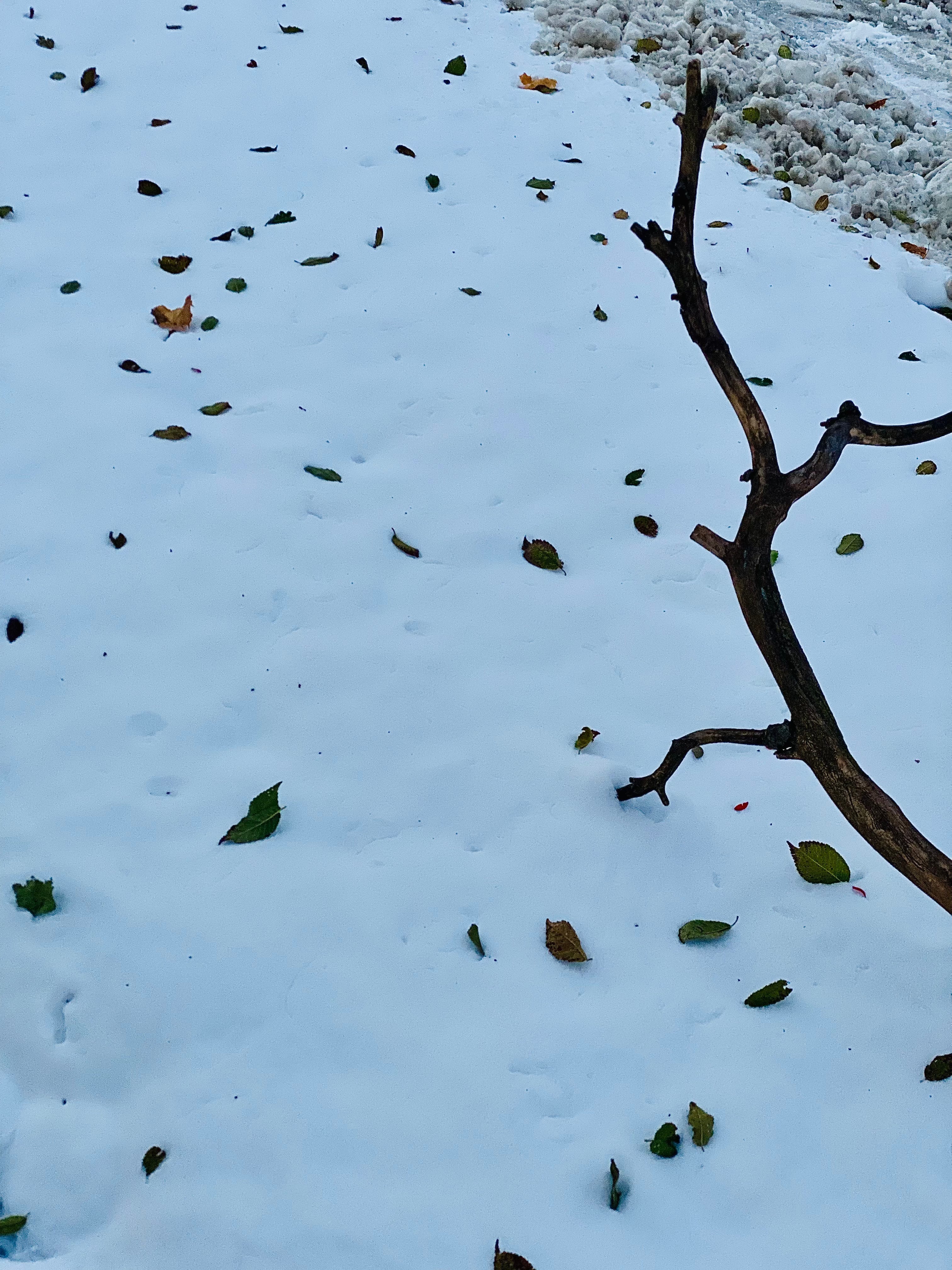
On Tuesday we woke up to shooting pains in P’s limbs, and also to snow. The night before, P took his first dose of chemo pills with a full glass of water and our hands squeezed tight together. His distressed stirring shot me into a flashback of the horrific summer nights when prescribed steroids interrupted his sleep with sharp stings and burning joints. In the half-sleep of waking up, I felt my heart drop into my stomach; here we are again, I thought with a mix of love, empathy, and dread. Cancer has been interruptions like this — to sleep, to work, to plans—with some breaks in between, but a sort of ever-present awareness that at some point we’ll be hurled again into a staccato pattern of living.
In her newsletter, interruptions, Cameron says this: “Interrupting requires something first to be continuous, or moving, time and progress taken for granted.” I think, for P and me, maybe the chaotic two years we’ve had as a couple have set us up nicely to feel less jolted by a lack of easeful continuity, but also it makes me sad—we’ve been striving for the luxury of taking progress for granted for as long as we’ve been together. When one roadblock is mended, another one has seemed to appear. We did not know that—on top of distance and grief and trauma and many hurtful mistakes— we would also be interrupted by a critical illness.
So, there we were, awake before 6am with his pain and a driveway covered in over a foot of snow. I asked what I could do, arms wrapping around him until he responded with a wince; I told him I was so sorry, my love. He had said, the night before, that he wanted to shovel before I set off on a legitimately treacherous commute, and I knew he meant it, but of course he could not shovel in this state. After checking again if I could bring him anything, I bundled up and went down to the driveway where there used to be a garage, one promised to be rebuilt by the house owner. I would have to shovel the driveway no matter what, but that I had several dozen feet more and a car to dig out because of my landlord’s pure negligence sent me into an absolute rage. My hands were freezing as I shoveled and hoisted, the motion re-triggering an injury that had finally begun to heal. “Fuck,” I said quietly at first, and then loudly, and louder still. “FUCK. Fuck this so much.” Fuck the landlord, fuck the extreme cold and the climate crisis, fuck P’s pain, fuck having to commute.
I thought back to shoveling my first year in this apartment. I was angry then, too, but mostly I was sad and heartbroken and scared. I remember one driveway-clearing morning, crying in 20 degree air, and having the most emo thought that my tears might freeze like icicles on my face. Snow shoveling is somatic processing.
This year’s rage and sadness were interrupted by an older woman in a big puffy red coat walking a snow-happy little pup. I was about to shout another loud “fuck” with a slam of the shovel (a necessary action to shake off matted snow, and also a complement to my emotional disregulation), when I realized another human was within ear shot. I stopped, made eye contact, forced a smile. She gazed at the driveway with a look of being genuinely impressed; “You’re doing a great job,” she said. She said this to me so sincerely, like she was really taking in what a barely 5’ girl who she probably heard shouting ‘fuck’ managed to do with a shovel before 7am. I could have projectile sobbed right there like a weepy cartoon character, but I swallowed the emotion to tell her “thank you.” (Sometimes interruptions disrupt the stuck, all-encompassing linear time of a difficult emotion.)
The commute was awful and nearly an hour longer than it usually is. I wondered if this great teaching gig was worth it, even if I do only have to commute 2-3 days a week; as I wrote about last month, the stress of car stuff is one of the hardest things for me, and I’ve already had several harrowing experiences this semester getting from point A to point B. I love teaching but it is the requirement of a paycheck to survive under capitalism that has ensured I drive dangerously on flat tires, with leaking gas tanks, and through blizzards. (And it is the ruthlessness of capitalism, that—although I have been working more than one job every year since grad school—car repairs are still financially burdensome.) As you can imagine, I was having a terrible start to the day.
It would be okay, I know, if I decided to stick with this telling of it. But here’s another version that, by Tuesday afternoon, I let myself entertain: P woke up with pain from chemo, and I felt sad but also lucky that I was there to love him, and lucky that we fell in love in a way that got him to leave Europe and move to a city that happens to be have one of the most highly-respected hospitals in the world. I had to shovel the driveway but it made me sweat and worked my muscles in a way that hurt a little, but also felt good enough to count as my morning exercise. The commute was long and slow and scary, but it gave me time to finish the Pamela Anderson memoir (on Audible), and, most importantly, I made it to campus in one piece. My students were brilliant and engaged, as always, and I knew that I was happy to have this job for now.
I am often teetering here, that space of “I am unmoored by this” and “I can make positive meaning of it.” I admire those who do not go to the places of extremes, but I also know that whether it is because I am traumatized, or an artist, or a person with a Pisces-heavy birth chart that I will likely be navigating extremities — sometimes dysregulatingly feeding them, sometimes integratedly evading them— the rest of my days.
Cancer and capitalism and cars, they can be unmooring things. And also daily, banal things. And also teachers, portals for deep wisdom. On Tuesday, I encountered each iteration.
love & solidarity,
raechel
Reading + Podcasts.
Michelle Tea’s review of her Thanksgiving was truly perfect — voicey, funny, Cher-heavy, hearty discussion of nutritional yeast….
My friend and comrade, Shuli Branson, wrote a brilliant and necessary reflection on Israel-Palestine from a Jewish anarchist perspective. This is a dense piece, but I encourage you to work through it, especially if you aren’t totally sure what’s meant by the concept of ‘the state.’
I’m not sure why the podcast Song Exploder isn’t on more regular rotation for me because everytime I listen to it, I learn so much and feel so inspired. On our drive, P and I listened to LykkeLi and Bjorn talk about writing and producing “I Follow Rivers” and Perfume Genius talk about “Slip Away.” They are short episodes, but each packed in reflections of love, dissonance, belonging, and so much more. The little teases of parts of the song leave you craving it in its entirety, and thankfully each episode ends offering exactly that.
I attended an Abolitionist Bystander Intervention training, and I think everyone should commit to learning skills to de-escalate conflict and interrupt harm without the help of the cops. A nice summary of the main points can be found here.
In class: Last week my student’s loved digging into M.E. O’Brien’s “Communizing Care,” which offers a lineage of and utopian imaginings of family abolition; this week we dug into indigenous cosmologies’ relationship to queer studies — we engaged Leanne Betamosake Simpson, Jodi A. Byrd, and Robin Wall Kimmerer, among others.
Watching.
Christmas movie season has arrived! We started (the week of Thanksgiving) with Little Women (2019), but Little Women (1994) is up soon (P hadn’t seen either!). We also watched The Family Stone, which has a sort of ridiculous plot point but is generally dark and well-acted and also very cozy. Elf, Love Actually, and The Holiday are my must-watch’s every year, so those three soon. I’d also like to get Home Alone in this year, and at least a few mindless Hallmark-esque flicks.

Listening.
P had never heard “Sunday Candy,” which is one of my favorite songs, and one I definitely consider Christmas-adjacent. The live version from SNL is particularly heartwarming. <3
Joy & Attention.
so many things from our road trip last week to visit P’s family: the autumn leaves, sunrises over the Rappahanock River, more kayaking, a great art exhibit, time with P’s friends and their sweetest kiddos, walks in the woods, beautiful conversations with his aging mammaw, and more. leaving the oven door open after baking something, feeling the warmth fill the kitchen like a song. making it safely to campus. the moving tributes to Shane McGowan; I hope very much that he left knowing he was loved. students. kitties and their aggressive cuddles. voice notes with friends. cozy, gray coffee shop days. love. an absolutely nourishing evening with my autotheory students/friends. holiday season things!. hot yoga. laughing (this week specifically with the new-to-me I Like to Watch with Trixie and Katya, which I discovered in preparation for our reality television unit in my Queering Media class). espresso. tea. lentils. love. & all of you, thank you. <3


thank you for everything, as always. but specifically for the abolitionist pocket zine--I just printed 19 out and will be distributing them to my grad students on wednesday!
Thank you Raechel. I know you know this already because it absolutely ripples out of your writing: I was thinking last week about how gratitude can help us really connect with the pain that life (and especially life under capitalism) can bring. I always sort of thought it was a balance between attending to the good and the bad, and resisting being consumed by the bad, but I think it's actually that to really connect with an impossibly difficult reality requires a foundation of love, care, joy - and the other way round too.
Maybe this reads as a bit trite when you're sitting in the fire. Hope not. Sending love x